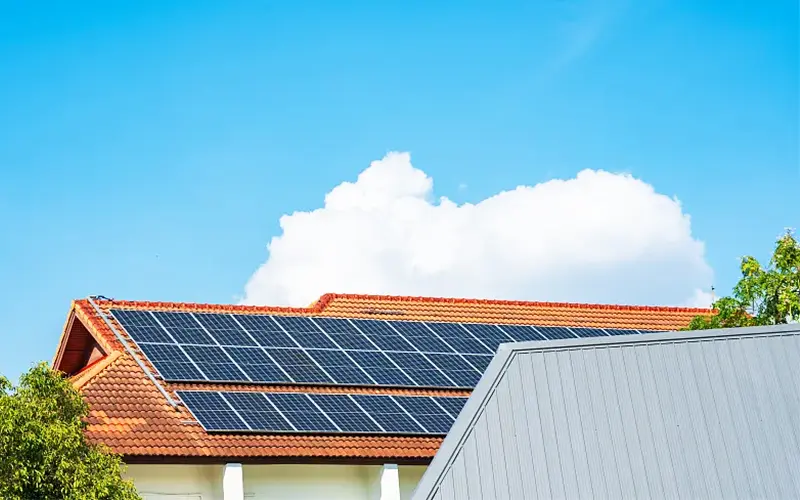
As electricity demand and prices continue to rise, the world is increasingly turning to renewable energy sources to meet its power needs. In recent years, solar energy has emerged as a leading renewable option, thanks to its declining costs and improving efficiencies.
A solar system is a setup that generates electricity by harnessing solar energy. A typical solar system includes solar panels (which capture sunlight), an inverter (which converts DC power to AC), a mounting structure (which secures the panels in place), batteries (to store excess power), a grid box, and the balance of system components (such as wires, nuts, and bolts). Solar systems are available in various sizes, such as 1 kW, 2 kW, 3 kW, 5 kW, 7.5 kW, and 10 kW.
What is Off-Grid Solar System (with Battery)?
An off-grid solar system, equipped with battery storage and backup capabilities, generates electricity during power outages or at night. It consists of four major components: solar panels, an inverter, a battery, and the balance of system (such as wiring and mounting hardware). These systems are highly popular due to their integrated power backup and ability to operate completely independently of the grid.
Off-grid systems are solar photovoltaic (PV) setups that are not connected to the national grid. They are also known as stand-alone PV systems. Energy produced can be consumed immediately or stored in batteries for later use.
How does an off-grid solar system work?
An off-grid solar system has four main components, a solar panel, solar inverter, battery, and balancing of the system. Solar panels generate DC Current in sunlight and store it in batteries. If you want to run DC applications (12V), such as Fans and lights, you need a charge controller. Whereas, if you want to run AC appliances (220V), you need an inverter that converts DC Voltage to AC Voltage. Nowadays, all inverters work automatically, that is the electricity generated by the solar system charges batteries and runs appliances directly. Also, batteries run appliances directly in case of power failure.
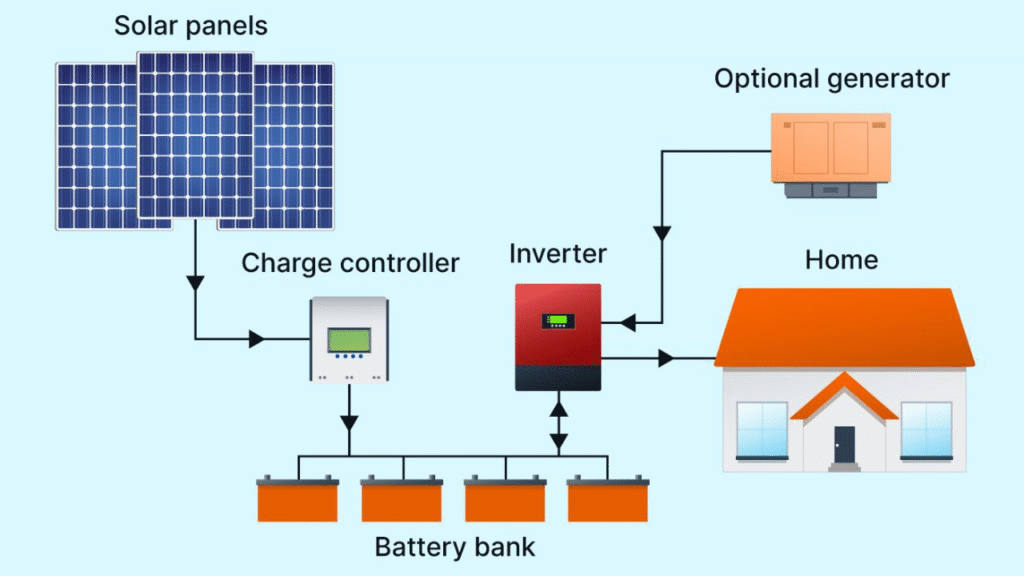
The 3-Blocks in every Off-Grid System:
- Production Block: Solar PV Modules
- Storage Block: Charge Controller & Battery Bank
- Usage Block: Solar Inverter & Switchboard
Off-Grid Overview/Components
1. PV Modules for energy production
2. Battery Bank for energy storage
3. Charge Controller for battery protection
4. Off-Grid Inverter for Current Conversion
How can I calculate an off-grid solar system?
Most home appliances, such as fans, TVs, coolers, ACs, water pumps, and so on, can run on this system. For instance, a 1 kW off-grid solar system is sufficient for a 2-4 BHK house. However, if you also want to run a 1 HP water pump in your home, a 3 kW off-grid solar system would be appropriate. If you plan to run an AC, you should opt for a 5 kW off-grid solar system. For commercial setups, such as shops, clinics, small mills, or petrol pumps, a 10 kW off-grid solar system is recommended.
This is the most common type of solar power system with backup functionality. It operates both day and night. During the day, the solar panels charge the battery while powering home appliances, such as air conditioners, coolers, televisions, and submersible pumps. At night, when sunlight is unavailable, the inverter runs your home appliances using the stored battery power.
Advantages & Disadvantages
Off-Grid Systems – Be Your Judge of this Technology.
The Top Advantages:
- Totally independent from the power grid
- Installed anywhere where energy is needed
- Many applanations
- Big savings in Power-Bills
The Top DISADVANTAGES
- High costs associated with energy Storage! Batteries represent 70% of the total cost.
- Low efficiencies (14%-19%) of PV Modules.
- Short Battery Lifespan, these need to be replaced at least 4-6 times in the lifetime of the PV system.
What is the difference between on-grid and off-grid solar systems?
The main differences between a grid-connected solar system (on-grid) and a stand-alone solar system (off-grid) are:
- An Off-Grid solar system will work even after a power cut, whereas an On-Grid won’t work.
- An off-grid solar system is more expensive than a grid-connected solar system.
What are the latest technology trends in solar inverters?
| Difference | PWM | MPPT |
| 1. Full Form | Pulse With Modulation | Maximum Power Point Tracking |
| 2. Efficiency | Up to 75% | Up to 95% |
| 3. Load | It only charges the Battery | It charges the battery & runs a home load during the daytime |
| 4. Cost | Less Price | Double Price of PWM |
| 5. Availability | For Single & Double Battery | More than 2 Batteries |
There are two types of solar inverters, 1) PWM Based – relatively low efficiency, and 2) MPPT Based – high efficiency
PWM Based – It stands for a pulse with modulation, these inverters are low on efficiency but prices are very low. For smaller needs, PWM-based inverters are recommended for smaller use such as running 3-4 fans, 8-10 lights, 1-2 Television, and 1 Refrigerator day and night.
MPPT Based – It stands for Maximum power point tracking. If your purpose of investment in solar is to save electricity bills, then it is strongly recommended to opt for MPPT-based inverters.
How much would an off-grid solar system cost?
Off-grid solar systems are available in various capacities to suit different applications, such as small homes, 2-3 floor homes, shops, offices, schools, warehouses, and more. The minimum capacity is 500 W, the average is 1 kW, and the maximum can range up to 10 kW (e.g., 3 kW, 5 kW, 7.5 kW, or 10 kW). For example, the cost of a 1 kW off-grid solar system with a single battery (12 V) is approximately ₹80,000, while one with double batteries (24 V) is approximately ₹1,00,000. The cost of any solar system depends on factors such as technology, brand, service, and warranty.
| Capacity | MRP (Inclusive of All Taxes) | Consumer’s Price (Inclusive of All Taxes) |
| 0.5 kW | ₹85,000 | ₹65,000 |
| 1kW | ₹150,000 | ₹96,000 |
| 3kW | ₹350,000 | ₹285,000 |
| 5kWh | ₹680,000 | ₹485,000 |
| 7.5kW | ₹1,150,000 | ₹665,000 |
| 10kW | ₹1,30,0000 | ₹950,000 |
How can I install an off-grid solar system?
Rooftop Solar systems are generally installed on a home’s roof, wall, tin shade, garden, door, etc. There are a few checks to be done before the installation of the solar panel stand, such as longitude and latitude angle, sun direction, wind pressure, wiring connection, area optimization, etc. To give the best installation according to customer needs, an engineer visit must be done.
VERTUS ENERGY is a trusted solar panel distributor in India when it comes to the installation of a solar system. The company has successfully installed solar systems all across India in states like West Bengal, Uttar Pradesh, Haryana, Maharashtra, Tamil Nadu, Kerala, etc. VERTUS ENERGY has the experience of installing 1 kW, 5 kW and 10 kW solar systems. Most of the installations have been done at residences, factories, transportation, hospitals, schools, offices, petrol pumps, etc.
What appliances will be running on an off-grid solar-powered system?
In an off-grid solar-powered system, how much power you can run depends upon the power of the Inverter and its efficiency, generally all inverter comes with 80% efficiency, so, if you buy a 3 kw Inverter system then up to 2,400 watts of peak power you can run at given point of time. A 1.5-ton inverter air-conditioner and 0.5 HP submersible can be run on a 3kW Solar System successfully.
- Agricultural: Used to power big energy users. Water Pumps for irrigation
- Industrial: Hospitals, Ocean Platforms, Factories
- Habitational: To power family houses with no access to regular electricity. To power residences that want to unplug from power lines.
- Power consumers: Boats, Campervans, Bicycles, Mobile Devices
How much does it cost to install a solar energy system?
The initial cost of installing a solar system is Rs. 25,000, if you have already a single inverter battery and Rs. 50,000 if you have already a double inverter battery. A 1 kWh solar system with a Battery will cost you around INR 105,000 if you buy it from VERTUS ENERGY. It can easily power a 3-4 BHK home and run smoothly for 8-10 hours.
A 3 kW off-grid solar system will cost you INR 2,85,000 if you buy from VERTUS ENERGY. It is used to power larger homes, shops and offices and can run smoothly for 8-10 hours. It is a powerful solar system and can easily support the running of fans, lights, televisions, refrigerators etc. but not a 2-ton AC. Available at INR 4,85,000,
5 kW solar system is used for running even larger homes, offices and commercial shops. 10 kW off-grid solar system can be easily used in offices, commercial shops and factories and comes with a price tag of INR 9,50,000. This system is capable of generating 50 units every day.